
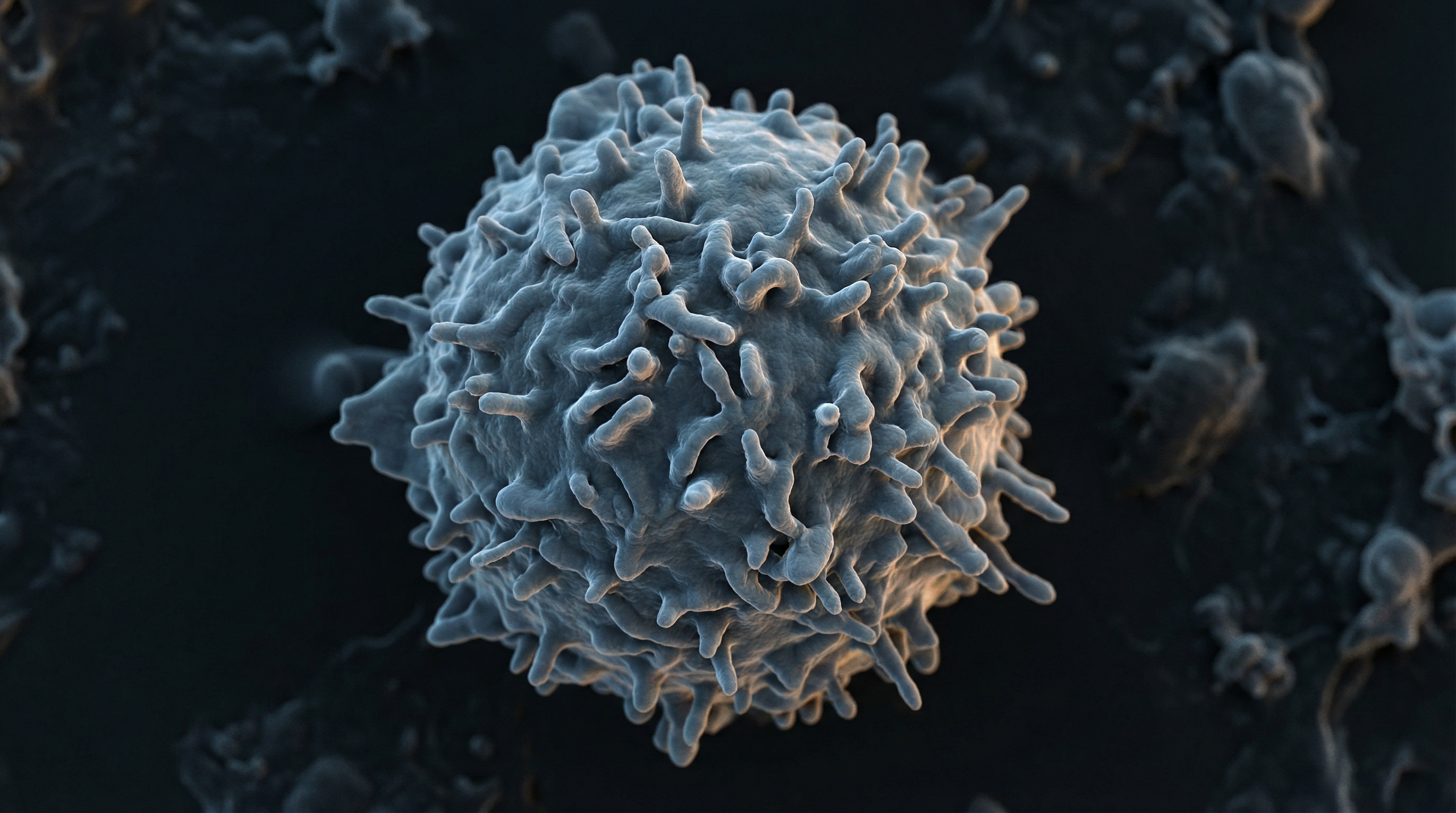
In 1966, a researcher named Allan Goldstein at the Albert Einstein College of Medicine began isolating the active components of the thymus gland — the small organ behind the sternum that serves as the training ground for T cells, the immune system's most targeted fighters. What he eventually identified was a family of peptides he called thymosins. The most clinically significant of these, Thymosin Alpha-1 (Tα1), is a 28-amino-acid peptide that appears to function as a master regulator of immune activation. It has since been approved in over 35 countries, studied in more than 2,000 clinical trials, and is now being actively investigated as an adjunct to modern cancer immunotherapy.[1]
What Thymosin Alpha-1 Actually Does
The thymus gland produces Tα1 naturally, but levels decline with age — the same pattern seen with many immune-regulating compounds. Tα1 appears to function primarily as a Toll-like receptor (TLR) agonist, binding to TLR-2, TLR-7, and TLR-9 on dendritic cells and macrophages. These receptors are part of the innate immune system's pattern-recognition machinery, and activating them initiates a cascade of downstream immune responses.[2]
A 2020 comprehensive review in World Journal of Virology catalogued the breadth of Tα1's immune effects: it induces production of IL-2, IL-10, IL-12, interferon-alpha, and interferon-gamma; it promotes the maturation of T-cell progenitor cells into functional CD4+ and CD8+ T cells; it directly activates natural killer (NK) cells; it primes dendritic cells; and it amplifies the activity of antioxidant enzymes including catalase, superoxide dismutase, and glutathione peroxidase — reducing oxidative damage that can impair immune function.[1]
A 2025 study published in Cancer Management and Research quantified some of these effects in advanced cancer patients. After a 7-day loading dose of Tα1, researchers observed significant increases in total T cells (from 422.5 to 614.0 cells/μL, P<0.001), CD4+ T cells (244.5 to 284.5 cells/μL, P<0.001), CD8+ T cells (159.0 to 222.5 cells/μL, P<0.001), and NK cells (159.8 to 224.1 cells/μL, P<0.001).[7] These are not marginal changes — they represent a substantial mobilization of the immune system's primary anti-tumor effectors.
The Tumor Microenvironment Problem — and How Tα1 May Address It
One of the central challenges in cancer immunotherapy is that tumors are not passive targets. They actively suppress the immune response around them, creating what researchers call an immunosuppressive tumor microenvironment. This environment is characterized by elevated myeloid-derived suppressor cells (MDSCs), tumor-associated macrophages polarized toward an anti-inflammatory M2 phenotype, and exhausted T cells that have lost their ability to kill.
Tα1 appears to address several of these mechanisms simultaneously. A 2025 study in Scientific Reports found that Tα1 promotes the transformation of tumor-associated macrophages from the immunosuppressive M2 type to the pro-inflammatory M1 type — effectively reversing one of the tumor's primary immune evasion strategies.[6] A 2024 study in American Journal of Translational Research demonstrated that Tα1 significantly reduced the proportion of MDSCs in the peripheral blood of non-small cell lung cancer (NSCLC) patients from 1.70% to 0.59% (P<0.05), and also reduced MDSCs within tumor tissue itself.[5]
A 2023 paper in International Immunopharmacology described this process as Tα1 converting "cold tumors" — those with low immune infiltration and poor response to immunotherapy — into "hot tumors" that are more susceptible to immune attack and checkpoint inhibitor therapy.[9]
Liver Cancer: The Strongest Clinical Evidence
Hepatocellular carcinoma (HCC), the most common form of liver cancer, has been the most extensively studied indication for Tα1. A meta-analysis of 16 randomized controlled trials examining Tα1 combined with transarterial chemoembolization (TACE) for unresectable HCC found a statistically significant improvement in the 1-year survival rate (odds ratio 2.43, 95% CI: 1.76–3.36, P<0.00001) and in the objective response rate (OR 1.54, 95% CI: 1.19–2.00, P=0.001).[3]
More recently, a 2025 retrospective study in Scientific Reports examined Tα1 combined with lenvatinib plus sintilimab (a PD-1 inhibitor) in unresectable HCC. The group receiving Tα1 had a median overall survival of 16 months compared to 11 months in the control group (P=0.018), a median progression-free survival of 7 months versus 4 months (P=0.006), and an objective response rate of 55.8% versus 34.7% (P=0.042).[6] Notably, there was no significant difference in the incidence of serious adverse events between the two groups — the survival benefit came without additional toxicity.
Lung Cancer: Meta-Analytic Evidence Across Eleven Trials
Non-small cell lung cancer (NSCLC) is the second major cancer type where Tα1 has accumulated substantial clinical evidence. A meta-analysis of 11 randomized controlled trials of Tα1 combined with chemotherapy for advanced NSCLC showed a statistically significant improvement in the objective response rate (OR 1.59, 95% CI: 1.23–2.05, P=0.0004) and in the 1-year survival rate (OR 2.03, 95% CI: 1.44–2.87, P<0.0001).[3]
A 2023 review in Frontiers in Immunology detailed the specific mechanisms at work in lung cancer: Tα1 inhibits tumor cell proliferation, migration, and invasion; it inhibits the STAT3 signaling pathway and its downstream effector MMP2 (which tumors use to invade surrounding tissue); and it reduces reactive oxygen species production while upregulating antioxidant enzymes that protect immune cells from the oxidative environment tumors create.[4]
A Phase 2 clinical trial (Gasto-1043) found that Tα1 significantly reduced radiation pneumonitis — one of the most serious complications of chemoradiotherapy in NSCLC — compared to controls, suggesting that in addition to its anti-tumor properties, Tα1 may protect healthy tissue from treatment-related damage.[4]
Melanoma: The Checkpoint Inhibitor Synergy Data
Perhaps the most striking data on Tα1 comes from melanoma research examining its interaction with checkpoint inhibitors — the class of immunotherapy drugs (including ipilimumab and pembrolizumab) that have transformed cancer treatment over the past decade.
A study reported in Onco Targets and Therapy (2025) found that metastatic melanoma patients treated with the CTLA-4 inhibitor ipilimumab who had previously received Tα1 had a 5-year overall survival rate of 41.2%, compared to 13.0% in patients who received ipilimumab alone (P=0.006).[8] The median overall survival was 38.4 months in the Tα1-pretreated group versus 8 months in the ipilimumab-only group.
The mechanism behind this synergy appears to involve Tα1's ability to increase CD8+ T cell infiltration into the tumor while simultaneously reducing immunosuppressive regulatory T cells (Tregs) at the tumor site. A preclinical study published in Life Science Alliance (2020) demonstrated that Tα1 potentiated the antitumor activity of anti-CTLA-4 therapy in mouse models by increasing CD8+ T cell infiltration, upregulating cytotoxic markers (GzmB and Perforin), and reducing Foxp3+ Treg cells in the tumor — without impairing the anti-tumor activity of the checkpoint inhibitor.[10]
The same study identified a second critical finding: Tα1 protects against checkpoint inhibitor-induced colitis, one of the most common and serious side effects of CTLA-4 blockade. By engaging the IDO1 tolerogenic pathway in the gut, Tα1 appears to prevent the intestinal immune pathology that limits the use of checkpoint inhibitors in some patients — while simultaneously enhancing their anti-tumor effect.[10]
Breast Cancer and the Abscopal Effect
In breast cancer, the evidence for Tα1 is earlier-stage but mechanistically compelling. A 2024 case report in Medicine described a patient with triple-negative metastatic breast cancer — one of the most difficult-to-treat cancer subtypes — who received Tα1 in combination with stereotactic body radiotherapy (SBRT) and a PD-1 inhibitor. The patient achieved a target lesion regression rate of -78.97% and an observed lesion regression rate of -56.73%, meeting criteria for partial response. Notably, the combination appeared to induce an abscopal effect — regression of tumors outside the radiation field — suggesting that Tα1 may help the immune system generalize a local radiation response into a systemic anti-tumor attack.[11]
A 2023 paper in International Immunopharmacology described the molecular mechanism: in the breast cancer microenvironment, Tα1 binds to phosphatidylserine on the surface of apoptotic tumor cells and, when internalized by macrophages, activates the SHIP1 pathway through TLR7/MyD88 signaling — reversing the M2 polarization of tumor-associated macrophages that would otherwise suppress the immune response.[9]
The Safety Profile
Across more than three decades of clinical use, Tα1's safety profile has been consistently favorable. The most common adverse effect is mild local irritation at the injection site. In clinical trials combining Tα1 with chemotherapy, combination therapy was associated with fewer infections, decreased neurotoxicity, and improved quality of life compared to chemotherapy alone — suggesting that Tα1 may partially protect against the immune suppression that chemotherapy induces.[1]
A 2023 review in International Immunopharmacology noted that Tα1 "acts without overstimulation of cytokine production" and does not appear to induce the serious side effects associated with other immune-activating agents such as interferon or interleukin-2 — agents that can cause severe flu-like symptoms, autoimmune reactions, and organ toxicity at therapeutic doses.[9]
The standard administration is subcutaneous injection at 1.6 mg, typically twice weekly. It is approved for clinical use in more than 35 countries under the brand name Zadaxin (thymalfasin), and active Phase 2 clinical trials are currently enrolling patients in NSCLC, advanced solid tumors, and combination immunotherapy settings.[1][12][13]
Where the Research Stands
Tα1 occupies an unusual position in the landscape of immune-modulating compounds: it has a longer clinical history than most peptides currently being studied, with regulatory approvals in multiple countries and a body of randomized controlled trial data that few peptides can match. At the same time, it is being actively re-evaluated in the context of modern immunotherapy — checkpoint inhibitors, combination regimens, and precision oncology — where its ability to enhance immune response while protecting against treatment toxicity may prove particularly valuable.
The 2019 reappraisal in Frontiers in Oncology summarized the current scientific view: Tα1 is not simply an immune stimulant but a context-dependent immune modulator — one that appears to amplify anti-tumor immunity where it is needed while maintaining immune homeostasis elsewhere.[2] That combination of efficacy and safety, if it holds up in ongoing trials, would make Tα1 one of the more clinically significant peptides in the immuno-oncology toolkit.
"Given the roles of Tα1 in regulating cellular immunities and exceptional safety profiles demonstrated in decades of clinical use, we believe that it is plausible to explore implications of Tα1 in the immuno-oncology setting by combining with ICI-based therapeutic strategies." — International Immunopharmacology, 2023
Editorial Note: This article is intended for educational purposes only and does not constitute medical advice. Thymosin Alpha-1 (thymalfasin/Zadaxin) is approved in over 35 countries but is not FDA-approved in the United States as a standalone therapeutic. All clinical decisions regarding peptide therapy should be made in consultation with a licensed medical provider.